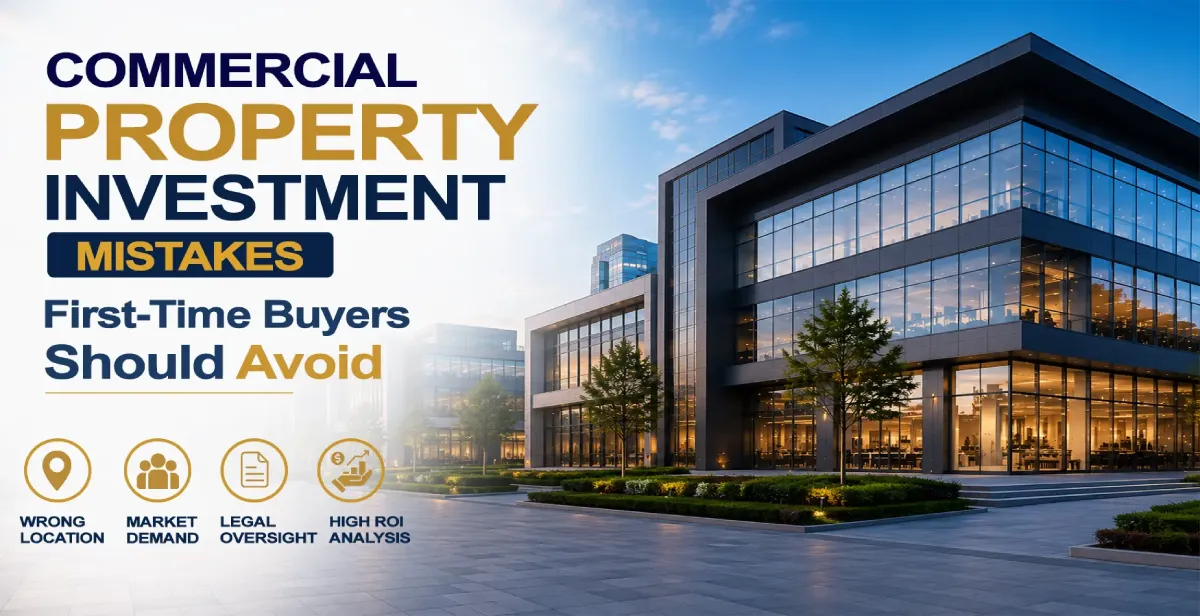
Commercial Property Investment: 9 Costly Mistakes First-Time Buyers Should Sidestep
Investing in commercial property can be a lucrative venture, but it's also fraught with pitfalls that can turn a promising investment into a financial burden. Unlike residential real estate, commercial properties demand a different approach—one that requires meticulous planning, market awareness, and risk assessment. Having analyzed over 50 commercial transactions in the Delhi-NCR region, we've identified the most common missteps that first-time investors make and how to avoid them.
In This Article:
- Why Commercial Property Isn’t Just "Bigger Residential Real Estate"
- The Due Diligence Trap: What Most Investors Miss
- Emotional Bidding Wars: The ROI Killer
- The Phantom of "Prime Location"
- Underestimating the Holding Period Reality
- The "Set It and Forget It" Fallacy
- Financing Fumbles: How Debt Structures Bite Back
- The Tenant Quality Blind Spot
- Case Study: How We Salvaged a Problematic Noida Office Investment
- Future-Proofing Your Investment: 3 Non-Negotiables
- Faq
Why Commercial Property Isn’t Just "Bigger Residential Real Estate"
Many newcomers assume commercial investments follow the same rules as residential properties—only with bigger numbers. This misconception leads to oversights in three critical areas:
-
Tenant Dynamics:
Commercial leases often run 3–10 years, unlike annual residential contracts. Vacancies last longer—our data shows an average 8-month vacancy period for retail spaces in Ghaziabad versus 2 months for apartments.
-
Cash Flow Sensitivity:
A single vacant unit in a 5-storey office building can slash your net operating income by 20% overnight.
-
Regulatory Complexity:
Zoning laws in areas like Hapur require specific commercial use certifications that residential properties don’t.
The Due Diligence Trap: What Most Investors Miss
While everyone checks title deeds and basic paperwork, these often-overlooked factors derail deals:
-
Hidden Encumbrances:
A 2025 Noida case showed 17% of commercial properties had undisclosed utility easements restricting signage placement—critical for retail visibility.
-
Traffic Flow Studies:
For TRG The Mall near Delhi Airport, we conducted 12-month pedestrian counts before finalizing the investment. Most buyers rely on developer claims rather than independent data.
-
Covenant Analysis:
Many miss restrictive clauses like "no competing businesses within 2km"—a death knell for future leasing flexibility.
Emotional Bidding Wars: The ROI Killer
The adrenaline rush of auctions and competitive bidding often leads to overpaying. Here’s how to stay disciplined:
-
Cap Rate Anchoring:
If similar properties trade at 7% cap rates, don’t rationalize paying a 5.5% equivalent because of "potential."
-
Renovation Reality Check:
That Class C office building won’t magically become Class A—construction costs have risen 22% year-over-year in Uttar Pradesh.
-
Exit Strategy First:
Before bidding, identify three potential buyer profiles (e.g., REITs, private equity, adjacent business owners).
The Phantom of "Prime Location"
"Location, location, location" is commercial real estate’s mantra—but prime means different things for different assets:
| Property Type | True Prime Indicators | Overrated Factors |
|---|---|---|
| Retail | Pedestrian intercept points | Highway visibility |
| Office | Public transit walkability | Prestigious address |
| Industrial | Last-mile delivery access | Proximity to city center |
Our TRG The Mall project succeeded by prioritizing metro-connected foot traffic over flashy highway frontage.
Underestimating the Holding Period Reality
Commercial properties aren’t liquid assets. From our portfolio analysis:
-
Average Time to Sale:
11 months (vs. 4 months for residential)
-
Carrying Costs:
Property taxes, security, and maintenance average ₹18/sq.ft/month during vacancies
-
Tenant Improvement Allowances:
Budget 6-9 months of rent concessions for build-outs
The "Set It and Forget It" Fallacy
Unlike residential rentals where tenants handle utilities and minor repairs, commercial properties demand active management:
-
Triple Net Lease Nuance:
Even in NNN leases, landlords often overlook roof maintenance clauses that trigger every 7-10 years.
-
CAM Reconciliation:
Common area maintenance charges frequently lead to disputes—require monthly audits.
-
HVAC Lifespans:
Replacements cost ₹25-40 lakh for mid-sized office buildings; most investors don’t amortize this properly.
Financing Fumbles: How Debt Structures Bite Back
Traditional home loans don’t translate well to commercial deals. Key differences:
-
Balloon Payments:
Many commercial loans require refinancing every 5-7 years—a risk when interest rates are volatile.
-
Personal Guarantees:
Unlike residential loans, most commercial loans aren’t non-recourse in India.
-
Debt Service Coverage Ratio (DSCR):
Lenders typically require 1.25x coverage—meaning your property must generate 25% more income than the mortgage payment.
The Tenant Quality Blind Spot
Chasing high rents from questionable tenants often backfires. Red flags we’ve learned to spot:
-
Over-reliance on One Industry:
A Gurugram office building lost 80% occupancy when fintech regulations tightened.
-
Financial Health Signals:
Request audited financials—a restaurant tenant showing 30%+ food costs is likely skimming cash.
-
Sublease Clauses:
Weak language allows undesirable subtenants that violate your property’s brand positioning.
Case Study: How We Salvaged a Problematic Noida Office Investment
In 2025, TRG acquired a distressed 50,000 sq.ft office building where the previous owner made three critical mistakes:
-
Ignoring Floor Plate Efficiency:
The 25,000 sq.ft floor plates only suited large call centers—a dying sector. We reconfigured them for hybrid coworking spaces.
-
Overlooking Column Spacing:
8-meter spans couldn’t accommodate modern tech office layouts. We added structural reinforcements at 6-meter intervals.
-
Mispricing Parking:
Charging ₹5,000/month per spot when market rate was ₹2,500 drove away tenants. We bundled parking into rents at ₹1,800 effective rate.
The turnaround took 14 months but ultimately achieved a 14% unlevered IRR—proof that even flawed purchases can succeed with operational expertise.
Future-Proofing Your Investment: 3 Non-Negotiables
Based on emerging trends from our latest market analysis:
-
EV Readiness:
Delhi-NCR’s 2027 mandate requires 5% of parking as charging stations—factor in electrical upgrades now.
-
Data Infrastructure:
New office tenants demand 10Gbps fiber availability—retrofitting costs 3x more than initial installation.
-
Climate Resilience:
Grade A buildings now need flood-proofing up to 1 meter—especially critical for basement assets.
FAQ
-
How much cash reserve should I maintain for a commercial property?
We recommend 6-9 months of total debt service plus operating expenses. For a ₹5 crore property with ₹3 lakh/month mortgage, maintain ₹25-35 lakh in reserves for vacancies, repairs, and unexpected assessments. -
Are REITs better than direct commercial property investment for beginners?
REITs offer liquidity and diversification but cap returns at 8-12%. Direct ownership can yield 15-25% IRRs but requires hands-on management. First-timers should consider fractional ownership platforms as a middle ground. -
What’s the biggest difference between residential and commercial property
Commercial properties depreciate over 40 years (vs. 30 for residential) but aren’t eligible for ₹2 lakh interest deductions under Section 24(b). However, you can offset rental income with entire depreciation amounts—a major advantage. -
How do I verify foot traffic claims for retail spaces?
Beyond manual counts, use tools like Placer.ai or ask for Wi-Fi ping data from existing tenants. We once discovered a mall’s claimed 50,000 daily visitors was actually 22,000 by analyzing anonymized mobile location data. -
Should I invest in standalone buildings or mixed-use developments?
Mixed-use projects like TRG The Mall offer better risk diversification—when office vacancies rise, retail and entertainment components often remain stable. However, they require more complex management expertise.