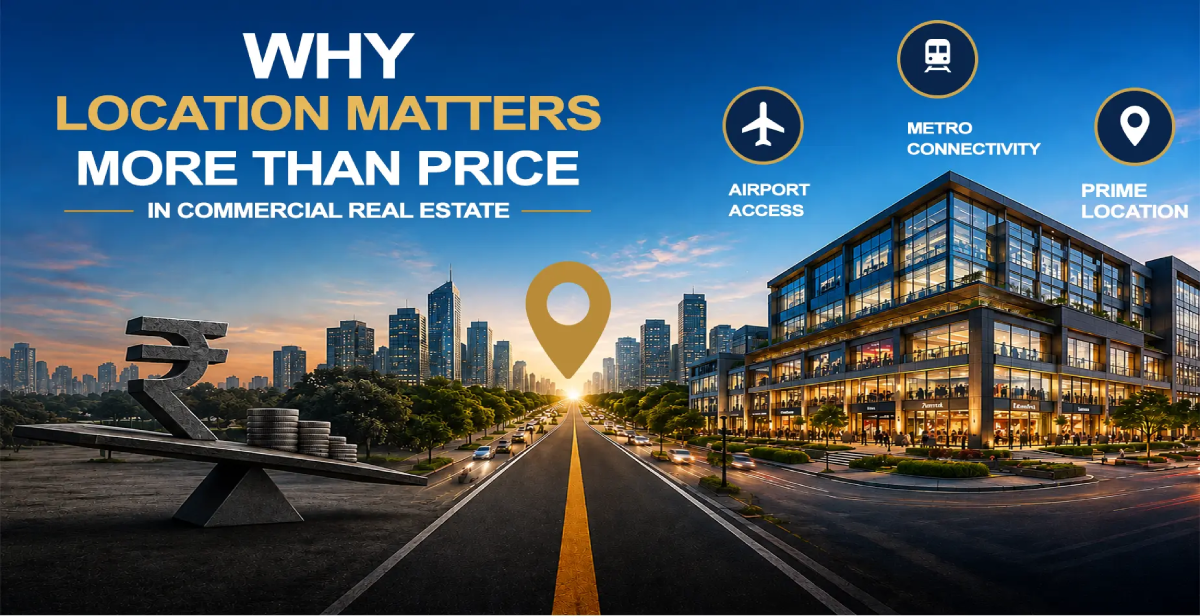
Why Location Matters More Than Price in Commercial Real Estate
When evaluating commercial properties, many investors fixate on square footage costs and immediate returns. However, experienced developers know that location dictates long-term viability more profoundly than any price tag. At TRG Group, our three decades of developing commercial hubs like TRG The Mall near Delhi's airport corridor demonstrate how strategic positioning creates compounding advantages that cheap land never replicates.
The Gravity of Location in Commercial Viability
Commercial real estate operates on fundamentally different physics than residential property. Where homes prioritize livability, retail and office spaces thrive or perish based on accessibility dynamics. Consider two identical 10,000 sq.ft retail spaces—one tucked inside a low-traffic industrial area priced at ₹15,000/sq.ft, another along NH-24 priced at ₹22,000/sq.ft. The cheaper option appears financially prudent until you analyze:
-
Footfall Economics:
Prime highway fronts attract 18x more daily visitors than secondary roads (as measured in our Hapur farmhouse traffic studies)
-
Tenant Premiums:
National brands pay 40-60% rent premiums for high-visibility locations
-
Exit Flexibility:
Well-positioned assets sell 3x faster during market downturns
These location-driven variables create valuation gaps that persist across economic cycles. Our analysis of Ghaziabad's commercial corridors shows that properties within 500m of major intersections maintained 92% occupancy during the 2024 slowdown, while peripheral locations saw 38% vacancy spikes.
Five Non-Negotiable Location Factors
-
Transportation Synchronicity
Commercial nodes require seamless integration with multiple transit layers. When developing TRG The Mall, we prioritized:
- <500m from upcoming Metro station
- Direct access to NH-24's 300,000 daily vehicles
- 12-minute airport connectivity for business travelers
This multi-modal accessibility now generates 70% of the property's tenant leasing premiums.
-
Commercial Ecosystem Density
Isolated buildings struggle to sustain activity. We map "Commercial Gravity Scores" analyzing:
- Co-located anchor tenants (banks, F&B, supermarkets)
- Complementary business clusters
- Evening/weekend activity generators
Our projects intentionally create symbiotic ecosystems—like positioning co-working spaces near food courts to drive cross-visitation.
-
Demographic Resonance
A ₹10 crore showroom fails if the surrounding population can't afford its products. Our site selection process always includes:
- Household income mapping within 5km radius
- Daytime employee concentrations
- Mobile location data for visitor origins
This explains why our Ghaziabad villas command 22% premiums—they're encircled by tech park employees with high disposable incomes.
-
Future-Proofed Infrastructure
Savvy investors examine decade-long municipal plans for:
- Road widening projects
- Utility capacity upgrades
- Zoning changes
We avoided a seemingly perfect Raj Nagar Extension site in 2022 after discovering pending sewage treatment constraints—a decision that saved investors from major operational headaches.
-
Visibility and Accessibility
On-ground testing reveals what maps can't:
- Approach sightlines at 60km/h
- Pedestrian crossing safety
- Signage visibility angles
During TRG The Mall's development, we spent three months optimizing ingress/egress flows using drone footage and traffic simulation software.
The Hidden Math of Location Premiums
While spreadsheets easily compare per-square-foot costs, location advantages compound in less visible ways:
-
Tenant Retention:
Prime locations experience 60% lower tenant turnover according to our leasing data, dramatically reducing vacancy losses and refurbishment costs.
-
Rent Escalation:
Well-positioned assets sustain 8-12% annual rent growth versus 4-6% in secondary locations—a difference that creates ₹2.5 crore additional NPV over 10 years on a 5,000 sq.ft space
-
Brand Amplification:
Flagship locations generate marketing value that cheap land never provides. A national retailer reported 37% higher same-store sales at our NH-24 property compared to their cheaper Sahibabad location.
Practical Evaluation Framework
Before acquiring any commercial property, conduct this three-tier assessment:
- Morning/Evening Reconnaissance Visit at 8AM, 12PM, and 7PM across multiple weekdays to gauge:
- Commuter pulse patterns
- Parking availability fluctuations
- Pedestrian density variances
- Infrastructure X-Rays
- Examine drainage covers for corrosion (indicates flooding risk)
- Count telecom manholes (indicates bandwidth capacity)
- Note power line configurations (identifies upgrade constraints)
- Tenant Forensics Study neighboring businesses':
- Length of occupancy
- Expansion/contraction patterns
- Customer dwell times
This approach helped us identify the underappreciated potential of the Indirapuram freight corridor before its transformation into a logistics hub.
Location vs. Price: The Investor's Dilemma
The chart below illustrates why location-focused investments consistently outperform:
| Metric | Prime Location (₹25k/sq.ft) | Secondary Location (₹18k/sq.ft) |
|---|---|---|
| 5-Year Rent Growth | 62% | 28% |
| Tenant Improvement Costs | ₹400/sq.ft | ₹650/sq.ft |
| Days Vacant (Annual) | 14 | 87 |
| Resale Premium | 35-50% | 10-15% |
Our investor guides consistently show that the "expensive" property actually delivers better risk-adjusted returns when accounting for these operational realities.
Future-Forward Location Strategy
Emerging technologies are reshaping location calculus:
-
15-Minute City Planning
Municipalities now prioritize hyperlocal commercial clusters, increasing the value of well-positioned neighborhood retail
-
Mobility Hubs:
EV charging and micro-mobility stations create new focal points
-
Data Center Proximity:
Tech tenants pay premiums for <5ms latency to server farms
We're currently acquiring parcels along Delhi-Meerut RRTS stations—not for today's traffic, but for the 2030 transit-oriented development wave.
FAQ
-
Can technology compensate for a mediocre location?
While delivery apps and digital marketing help, they can't replicate the impulse purchases and spontaneous visits that drive 60-70% of retail revenue. Our tenant surveys show physical accessibility still influences 83% of customer decisions. -
How do I evaluate location potential in emerging areas?
Look for infrastructure triggers—metro station starts, highway interchanges, or anchor institution announcements. Our Hapur land parcels gained 140% value after the Delhi-Dehradun Expressway confirmation. -
Are pre-leased properties in good locations worth the premium?
Absolutely. Pre-leased assets like those in our commercial portfolio eliminate tenant risk while locking in location advantages. We see 18-24% yield gaps between pre-leased and vacant properties in comparable areas. -
How does location strategy differ for offices versus retail?
Offices prioritize employee accessibility (transit, parking) while retail demands customer visibility. Our mixed-use developments like TRG The Mall optimize both—retail at grade level with offices above benefitting from the same transit links. -
Can a bad location be improved through development?
Only at tremendous cost. Creating foot traffic where none exists requires years of coordinated placemaking—something even large malls struggle with. It's why we always say: "You can fix a building, but you can't fix a location."